He has gone from accused minor criminal to community symbol. Let there be no mistake. As was confirmed after Tuesday’s court hearing, this is not just another harassment case. Charles Schmidl stands as a crusader for a cause.
The cause is the right of an adult to defend himself — and his 5-year-old son — against the alleged abuse of an out-ofcontrol 10-year-old. It is a line in the sand against lax parenting and the obnoxious offspring that it produces. It is a voice for the rights of those wronged by every spoiled brat spawned by absent or permissive parents.
In an era when discipline seems to have gone out of style and responsibility hides under a rock, this thing is bigger than Charles Schmidl. Or any one of us.
Schmidl is 38, trim and tanned, with an athlete’s stride. He did not imagine becoming the face of Enraged Adults Everywhere when he took his son for a mid-April skate at the Amherst Pepsi Center. A 10-year-old with a hockey stick, according to Schmidl, taunted him, shot pucks at him and his boy and dared him to do something about it.
Schmidl said he searched for 40 minutes in vain for security or staff at the center, then took matters into his own hands. He grabbed the kid and dragged him off the ice. The boy’s mother appeared and had Schmidl arrested.
Amherst cops say witness accounts largely confirm Schmidl’s story. The boy has had previous trouble at the rink, and his family is “familiar” to Amherst police.
In the court of law, Schmidl faces charges of harassment and endangering the welfare of a child. In the court of public opinion, Schmidl is a hero. I got dozens of e-mails after previously writing about the case, mostly defending his actions.
Schmidl emerged unrepentant from Tuesday’s court hearing.
“The [court] will hopefully provide the [justification] for what I believe,” Schmidl said. “[Protecting] my son is the most important thing for me.”
Schmidl’s attorney did most of the talking, but the message was clear: The case is less about the law than it is about principles.
I do not condone putting hands on somebody else’s kid. As a matter of law, I think Schmidl loses. As a matter of common sense, he’s an action hero: Justifiable Avenger of the League of Authority.
Schmidl merely did what the boys’ parents ought to have done long ago: ladle out a generous helping of discipline.
No kid is perfect. No adult is perfect. But when a 10-year-old uses an adult for target practice, it says to me that the parents have not been minding the store. It takes a lot of parental coddling, excusemaking and myopia to produce a minimonster of this magnitude.
Instead of turning the other cheek, Schmidl stood his ground. Instead of meekly walking away, Schmidl refused to be abused. I am not saying that it was the smart thing to do. But given the situation, I can understand and even sympathize with it.
Maybe the full story will be told only in court. But if what we heard reflects what happened, Schmidl stands for the parent of every kid who has been victimized. He is the symbol of every adult who puts up with somebody else’s parenting mistake.
“My client intervened because he had to,” said attorney James Hartt. “I believe the people of Buffalo understand what [Schmidl] did. . . . He did what he had to do to have the kid held accountable.”
Odds are that it will not play in court. But in the court of public opinion, Schmidl is a crusader for a cause.
If bad parenting were a crime, Schmidl stands as society’s superhero. The court may punish him. The rest of us want to pat him on the back.
Donn Esmonde
link

Thursday, June 7, 2007
Esmonde: Schmidl’s role of avenger is justifiable


Wednesday, June 6, 2007
Open Letter To The Guy Who Stole My Car
Guest ranter-writer: Anthony Savona
B-Team Note: Tony's car was recently stolen from a suburban NY train station parking lot. This is his 'open letter' to the still unknown thief.
An Open Letter To The Guy Who Stole My 11-Year Old Piece-Of-Junk Car
Dear Sir:
I don't know what attracted you to my car from the hundreds surrounding it in the Long Island Railroad commuter parking lot. Maybe it was the glimmer of metallic silver popping out from beneath the flaking bits of black paint. Perhaps it was the large piece of electrical tape covering the thin strip of what used to be plastic between the driver-side front and rear doors.
Whatever it was, something about my 1993 4-door Honda Civic with the deep dent above the left wheel well called out to you. You needed it, so you took it.
And that's okay. I'm sure I maintained my dignity walking around the parking lot trying to look like I knew where I left my car for over half an hour. When I finally realized it had left the premises without me, I became concerned because, as I'm sure you've realized by now, the car has some -- well, let's just call them "quirks" -- that you, as new owner of the piece-of-crap car, will have to deal with.
For starters, the head gasket blew just last week. Now I'm no mechanic, but, as I've been told, that's the reason why the temperature gauge shoots past the "H" and you get that nice hissing sound when you turn off the engine after a particularly hot ride. It costs about $1,100 to fix, but shop around. Maybe I was just getting hosed.
Oh, and you can't just put the key in and start the car (not that you have a key). You see, the gear lock sticks for some inexplicable reason -- alright, I never had it checked -- so you need to stick the key (or whatever you're using) in the gear release to shift out of park.
I'm sure that all of this means nothing to you because you probably just took it to some chop shop for the valuable decade-old Honda parts - assuming, of course, that the shop was local enough for you to make it without overheating.
If you do find yourself stuck on the side of the road, dig through the glove compartment -- I think my current AAA card is still in there. Maybe they can tow you the rest of the way.
So, in closing, enjoy your new possession, which I understand is now legally 9/10ths yours, and may it provide you with the cash to hold you over until you work up the nerve to steal a nice car.
I would, however, like my CDs back.
Sincerely yours,
Anthony Savona
Long Island, NY
*Anthony Savona is a writer and commuter who lives in the NY area.
B-Rant
http://www.burbia.com/node/1170
Beyond Bush: What the world needs is an open, confident America.
June 11, 2007 issue - In the fall of 1982, I arrived in the United States as an 18-year-old student from India. The country was in rough shape. That December unemployment hit 10.8 percent, higher than at any point since World War II. Interest rates hovered around 15 percent. Abroad, the United States was still reeling from Vietnam and Watergate. The Soviet Union was on a roll, expanding its influence from Afghanistan to Angola to Central America. That June, Israel invaded Lebanon, making a tense situation in the Middle East even more volatile.
Yet America was a strikingly open and expansive country. Reagan embodied it. Despite record-low approval ratings, he exuded optimism from the center of the storm. In the face of Moscow's rising power he confidently spoke of a mortal crisis in the Soviet system and predicted that it would end up on "the ash heap of history." Across the political aisle stood Thomas (Tip) O'Neill, the hearty Irish-American Speaker of the House, who personified the enormous generosity and tolerance of old-school liberalism. To a young foreign student the country seemed welcoming and full of promise.
Today, by almost all objective measures, the United States sits on top of the world. But the atmosphere in Washington could not be more different from 1982. We have become a nation consumed by fear, worried about terrorists and rogue nations, Muslims and Mexicans, foreign companies and free trade, immigrants and international organizations. The strongest nation in the history of the world, we see ourselves besieged and overwhelmed. While the Bush administration has contributed mightily to this state of affairs, at this point it has reversed itself on many of its most egregious policies—from global warming to North Korea to Iraq.
In any event, it is time to stop bashing George W. Bush. We must begin to think about life after Bush—a cheering prospect for his foes, a dismaying one for his fans (however few there may be at the moment). In 19 months he will be a private citizen, giving speeches to insurance executives. America, however, will have to move on and restore its place in the world. To do this we must first tackle the consequences of our foreign policy of fear. Having spooked ourselves into believing that we have no option but to act fast, alone, unilaterally and pre-emptively, we have managed in six years to destroy decades of international good will, alienate allies, embolden enemies and yet solve few of the major international problems we face.
In a global survey released last week, most countries polled believed that China would act more responsibly in the world than the United States. How does a Leninist dictatorship come across more sympathetically than the oldest constitutional democracy in the world? Some of this is, of course, the burden of being the biggest. But the United States has been the richest and most powerful nation in the world for almost a century, and for much of this period it was respected, admired and occasionally even loved. The problem today is not that America is too strong but that it is seen as too arrogant, uncaring and insensitive. Countries around the world believe that the United States, obsessed with its own notions of terrorism, has stopped listening to the rest of the world.
Curb Appeal: One Of My Best Investments Yet Or How I Turned $80 Into $5,000 With Minimal Risk
Tree planting pays dividends not just for the environment but also for your pocket. Here’s how.
A while back, I came across Money Smart Life’s post on his incredible rate of return. I chuckled evilly as I recalled how I have beaten his returns in my own virtually no risk scenario, although it did take me three years to do and the wealth involved here is “tied up”.
Let me first say that in order to make this same investment work for you, there are a few prerequisites.
- #1 Do you own the land you live on?
- #2 Do you live in the city or in a suburb?
If you answered YES to these, then it could be worth reviewing what you can do with a little bit of your land and just a few dollars.
Despite vaguely sounding like an infomercial, my claim of making some big bucks out of a few is true, though it would entail thinking a little bit outside of the box. So what is this investment about?
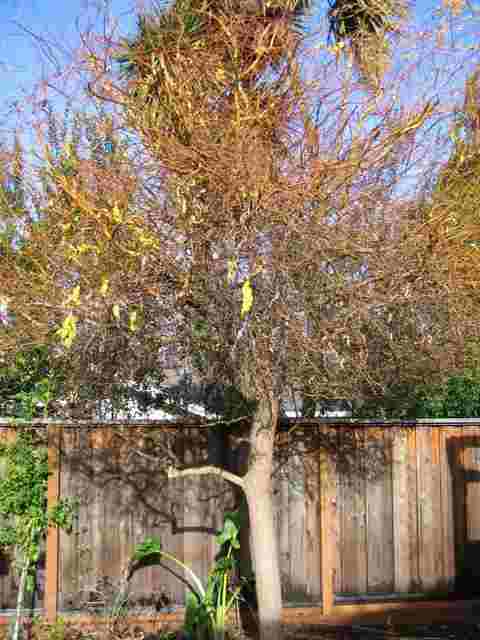
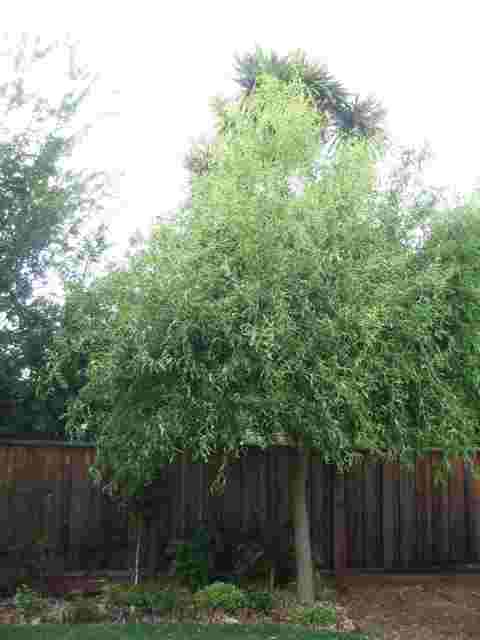
It’s about how I spent a mere $80 for something that is now valued at around $5,000 (or possibly higher) for a tidy return of 6,150%. What that thing is, is no other than my back yard’s most prominent tree: a large Curly Willow, which started out as a lowly sapling bought for tens of dollars. The sapling was but a wisp of a stick with some tendrils at the end. Today, proudly it stands, three years later, soon to be a commanding presence.
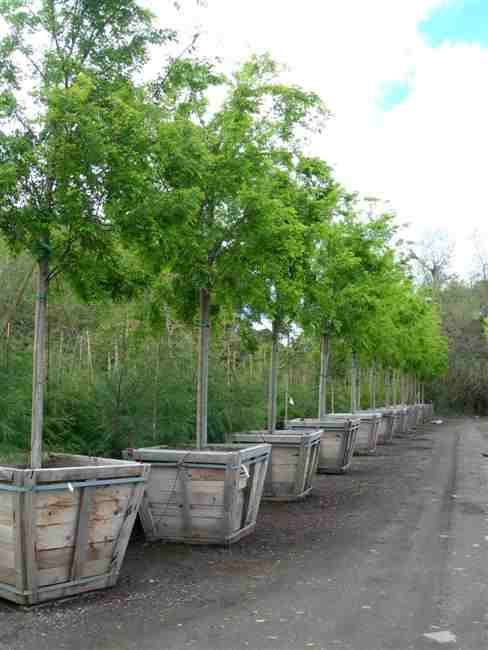
When we went to the nursery to choose ourselves a tree, we purchased something that looks like this, except with a dramatically skimpier crown (image credit: Turned Earth):
Here’s what it looked like this winter:
And now in the late spring:
So how did I get to thinking that this tree is worth $5,000? Well you can always get a tree appraised. I have a friend who is also a landscape designer (in California, the landscaping school of choice is Cal Poly, which apparently produces top graduates in this field) who tells me so. He told me how he charges at least $20,000 to install larger, mature trees on client projects.
In several more years, I’ve been told by appraisers that I’ll double that current value from $5,000 to $10,000. At its mature state at fifteen years old, this tree would be worth $20,000. But I won’t be seeing that money until after I sell my house as it’s going to be folded into our home valuation.
When I first heard how trees were priced this way — I mean, even a small Japanese Maple all of 5 feet tall can command up to $2,000 in the Bay Area — I couldn’t believe it. But after reading up on this, I figured this would be a great way to contribute to the value of a home, as overall curb appeal adds 20% more to a property’s value, rivaling returns made by adding a new bathroom or kitchen. What’s also terribly interesting is that a swimming pool recovers only 20% - 50% of its installation costs, while curb appeal will recoup 100% to 200% upon resale, so sayeth this article.
So with all this talk, do you wonder what makes these trees so costly when they’re fully grown?
The Value Of Mature Trees (Or Why They Cost So Much)
They’re difficult to replace.
If anyone tried to damage your tree, you can potentially file for a homeowner’s or property insurance claim and collect. Imagine having to do this!
Trees are an investment of time.
They are highly valued because they take a while to mature and to reach their full glorious potential.
They are used for aesthetics and curb appeal.
It adds a significant first impression to your home. You get to be known as the house with the so-and-so tree. This is the obvious reason why you’d like to have a tree to mark your territory.
They offer great shade and insulation for your home.
I used to live in a neighborhood that hardly had any trees because it was a new suburb. Let me tell you how I boiled and baked in the summer months forcing us to install central air conditioning to survive. When I visit other homes that are surrounded by more mature landscapes, there’s a noticeable change in temperature around the home, and I am all but envious they can get away without needing central air conditioning. They also insulate you from wind and snow.
They offer some recreation.
Wouldn’t it be nice to enjoy the outdoors right where you live? A big tree is a nice place to hang out to have yard picnics or just to relax. You can hang swings on your tree if it has larger, sturdier branches, or even build a tree house in the way numerous families have done.
They offer privacy and screening.
Even a fence is no longer enough sometimes. This is the main reason we have the tree where it is. I don’t see my neighbors sliding glass doors anymore.
Trees counter pollution.
What do I mean? Trees improve air quality, with one huge 30 foot tree providing an average household a clean source of air and enough oxygen for a whole day. Beyond providing the usual and expected green effect, trees also block noise and light.
They limit erosion.
If you live on a hill or on an area with slopes, then trees will help you keep your ground intact and prevent erosion and flooding.
If you’re keen on starting a planting project, check out this guide first for best results.
So yes, if you want to raise your home’s valuation on the cheap, you don’t need to build a swimming pool, install a patio, hot tub or gazebo. You can just spend the money on some organic items and watch your valuation grow along with your trees and plants.
By Silicon Valley Blogger
link
Students invent powdered booze
• Dutch students invent powdered alcohol that can be sold to minors
• Adding water to powder creates fizzy-lime flavored liquid
• Innovation is called Booze2Go
Dutch students have invented powdered alcohol which they say can be sold legally to minors.
The latest innovation in inebriation, called Booz2Go, is available in 20-gram packets that cost €1-1.5 ($1.35-$2).
Top it up with water and you have a bubbly, lime-colored and -flavored drink with just 3 percent alcohol content.
"We are aiming for the youth market. They are really more into it because you can compare it with Bacardi-mixed drinks," 20-year-old Harm van Elderen told Reuters.
Van Elderen and four classmates at Helicon Vocational Institute, about an hour's drive from Amsterdam, came up with the idea as part of their final-year project.
"Because the alcohol is not in liquid form, we can sell it to people below 16," said project member Martyn van Nierop.
The legal age for drinking alcohol and smoking is 16 in the Netherlands.
The students said companies interested in making the product commercially could avoid taxes because the alcohol was in powder form. A number of companies are interested, they said.
Copyright 2007 Reuters. All rights reserved.This material may not be published, broadcast, rewritten, or redistributed.
http://www.cnn.com/2007/WORLD/europe/06/06/powdered.booze.reut/index.html?eref=rss_topstories
Buzz Over Mayor’s ‘Get a Life’ Remark
On Monday, the day before a fourth man in a suspected plot to bomb jet fuel tankers at Kennedy International Airport turned himself in to the authorities, Mayor Michael R. Bloomberg waded once again into the emotional discussions of how ordinary residents can conduct themselves in a post-9/11 world.
WCBS-TV quoted Mr. Bloomberg as saying:
There are lots of threats to you in the world. There’s the threat of a heart attack for genetic reasons. You can’t sit there and worry about everything. Get a life.
The mayor added, “You have a much greater danger of being hit by lightning than being struck by a terrorist.”
Digg, a Web site that allows news readers to share articles with each other, has been fairly abuzz with readers who’ve highlighted the WCBS-TV item.
By Sewell Chan
http://empirezone.blogs.nytimes.com/2007/06/06/buzz-over-mayors-get-a-life-remark/
This Russian risk could yet dwarf our blunder on Iraq
Putin's belligerence is the upshot of inept western diplomacy. Following cold war with cold peace may prove a historic error
Will history tell us we were fools? We worried about the wrong war and made the wrong enemies. In the first decade of the 21st century the leaders of America and Britain allowed themselves to be distracted by a few Islamist bombers and took easy refuge in the politics of fear. They concocted a "war on terror" and went off to fight little nations that offered quick wins.
Meanwhile these leaders neglected the great strategic challenge of the aftermath of cold war: the fate of Russia and its mighty arsenals, its soul tormented by military and political collapse, its pride undimmed. They danced on Moscow's grave and hurled abuse at its shortcomings. They drove its leaders to assert a new energy-based hegemony and find new allies to the south and east. The result was a new arms race and, after a Kremlin coup, a new war. Is that the path we are treading?
When Keynes returned from Versailles in 1919 he wrote an attack on the treaty that ended the first world war. In The Economic Consequences of the Peace he warned that punishing Germany and demanding crippling reparations would jeopardise Europe's stability and the building of German democracy. He confronted politicians, on both sides of the Atlantic, puffed up with the vanity of victory and convinced that the German menace had been laid to rest. He was right and they were wrong.
For the past six years Washington's whirling dervishes have reduced Anglo-American foreign policy to a frenzy of bullying hatred of anyone to whom they take a dislike. One half of this neoconservative agenda is heading for the rocks, American dominance in the Middle East following a stunning victory over a Muslim state. But the other half is alive and well, pushing ahead with the missile defence system bequeathed by the Reagan administration.
This so-called star wars is militarily unproven and, with the end of the cold war, of no apparent urgency. But it is astronomically expensive and, as such, has powerful support within America's industry-led defence community. When Dick Cheney was finding George Bush a defence secretary in 2000, Donald Rumsfeld's chief qualification was his enthusiasm for space-based defence. Hence America's 2002 renunciation of the anti-ballistic missile treaty. Hence the installation of defence systems in Poland and the Czech Republic, in defiance of what was promised to Russia at the end of the cold war. Hence Rumsfeld's frequent jibes against old Europe in favour of "new".
Vladimir Putin's reactive threat this week to retarget his missiles at west Europe was reckless and stupid. Just when nuclear disarmament is again a live issue and his old enemy, Nato, faces defeat in Afghanistan, he tossed red meat to the Pentagon (and Whitehall) hawks. He strengthened the case for a new British Trident and encouraged an arms race that he knows his own country can ill afford, just as it can ill afford to send Europe frantically seeking alternative energy supplies.
Yet nations do not always act rationally, especially those with authoritarian rulers. Putin's belligerence was the predictable outcome of a western diplomacy towards Russia whose ineptitude would amaze even Keynes. Nato's dismissal of Moscow's approach for membership, like the EU's similar cold shoulder, wholly misunderstood Russian psychology. The loss of its east European satellites was not just a loss of empire but revived age-old border insecurity. The pretence that Rumsfeld's installations, which could be placed anywhere, were aimed at "rogue states such as North Korea" was so ludicrous that only Tony Blair believed it.
There was a moment after 1990 when Russia was weak, immature and unstable, and longed for the embrace of friendship. Mikhail Gorbachev, Boris Yeltsin, Margaret Thatcher, Bill Clinton, even Blair in his pre-poodle phase, understood this. Neither side had an interest in reviving the cold war. Under Bush this has been replaced by an assumption that he should somehow dictate the terms of Russia's conversion to capitalism and democracy, even as western leaders cringingly paid court to the dictators of Beijing. This undermined Moscow's internationalists and played into the hands of Putin's hard-liners. It was repeated in Bush's speech in Germany yesterday.
Putin is throwing down a gauntlet not to the west so much as to his own Kremlin successors. He is warning them never to trust the west. To him it remains incorrigibly imperialist, hypocritical in its global morality and unreliable in its treaties. So he is telling them to cause mischief with oil and gas. Deny help over Iran and Kosovo. Stay armed and on guard.
A new study by Ian Kershaw, Fateful Choices: Ten Decisions that Changed the World, examines the options facing world leaders in 1940-41: should Hitler attack Russia; should Japan expand west or south; should America enter the war? The answers now seem embedded in the concrete of history but at the time they might have gone otherwise. Like the 1914 shooting of the Archduke in Sarajevo, the events that trigger conflict are easy to see with hindsight. At the time they might have turned on a penny.
The task of statecraft is to detect the pennies. Were Nato and Europe wise to snub Russia and thus, de facto, dig a new political ravine across Europe? Was America wise to provoke Russia's generals by moving its military presence close to their borders? While defending the west's commercial interests required a firm line, was it wise to visit on Moscow a stream of criticism of its internal regime? Now the west wants to stir Russia's historic ally, Serbia, into nationalist fury by "granting" independence to Kosovo. Why should Russia tell Belgrade to acquiesce and demand from Europe some economic quid pro quo? Why not sit back and laugh as America and Britain find themselves policing yet another Balkan civil war?
We may be witnessing only the paranoid exchanges of three world leaders on their way out. For all its ailments the world is incomparably more stable than it was in 1940. But a strategic risk is being taken with Moscow, and therefore by Moscow in return. Who knows that the Iraq war may seem a footling incompetence alongside the west's misjudgment of Russia over the past decade? Following cold war with cold peace may yet prove a historic error. And it was gratuitously unnecessary.
Simon Jenkins
simon.jenkins@guardian.co.uk
http://www.guardian.co.uk/Columnists/Column/0,,2096395,00.html


